
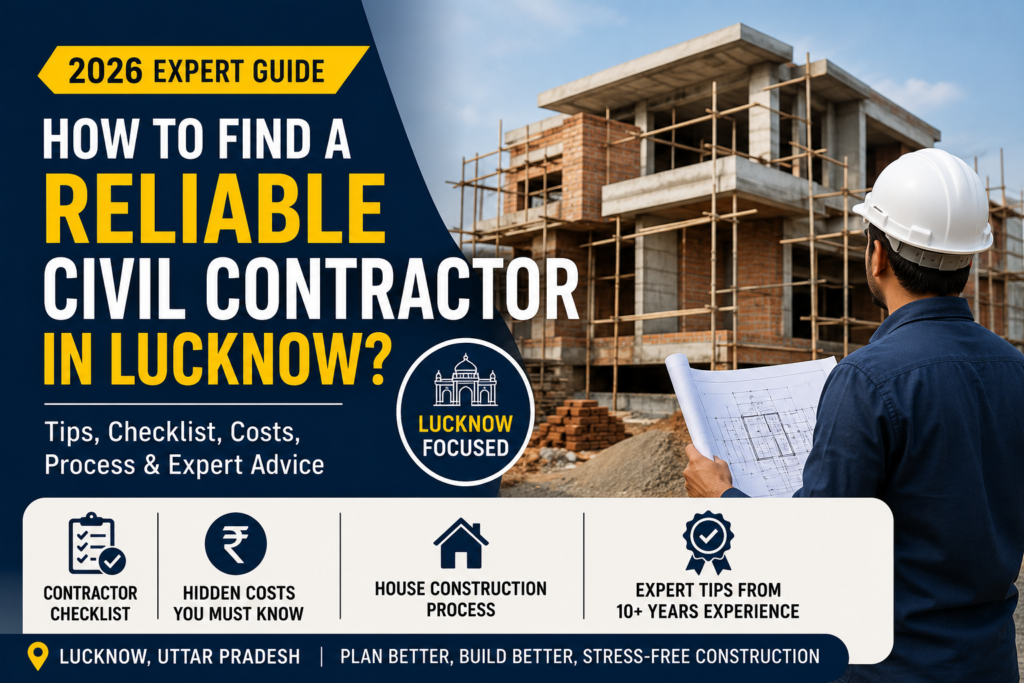
Building your dream home in Lucknow? Learn how to choose a reliable civil contractor with practical advice from a residential construction expert with over 10 years of experience. This guide covers common hiring mistakes, contractor comparison tips, hidden costs, and the questions every homeowner should ask before signing a construction agreement.
Why Choosing the Right Civil Contractor Matters
For most families, building a home is a once-in-a-lifetime investment. It’s not just about constructing walls and a roof—it’s about creating a space where memories will be made for years to come.
Yet, one of the biggest mistakes I see homeowners make is spending months selecting tiles, paint colours, or kitchen designs while choosing a contractor after just one or two meetings.
After working on residential construction projects in Lucknow for more than 10 years, I’ve realised that most construction problems don’t begin with cement or bricks—they begin with the wrong contractor selection.
A reliable contractor can help you stay within budget, maintain quality, and complete the project with fewer surprises. An unreliable one can lead to delays, additional expenses, poor workmanship, and unnecessary stress.
That’s why choosing the right civil contractor is one of the most important decisions you’ll make before construction begins.
Who Is a Civil Contractor?
A civil contractor is responsible for executing your construction project from start to finish. Unlike someone who only supplies labour, a civil contractor coordinates every stage of the project to ensure the finished house matches the approved drawings, quality standards, and agreed specifications.
Their responsibilities typically include:
- Site planning and layout
- Foundation and RCC work
- Brick masonry
- Labour management
- Material coordination
- Plumbing and electrical coordination
- Site supervision
- Quality inspections
- Construction scheduling
- Final finishing and handover
In simple words, a civil contractor acts as your construction partner throughout the project.
Civil Contractor vs Builder vs Labour Contractor
This is one of the most common areas of confusion for homeowners. Many people use these terms interchangeably, but they perform very different roles.
| Aspect | Civil Contractor | Builder | Labour Contractor |
|---|---|---|---|
| Primary Role | Executes the complete construction project on behalf of the homeowner. | Develops and sells residential or commercial projects. | Provides skilled and unskilled labour only. |
| Who Owns the Project? | Homeowner | Usually the builder | Homeowner or civil contractor |
| Scope of Work | Planning, procurement, supervision, quality control and execution. | Land acquisition, approvals, construction and selling. | Labour execution only. |
| Material Responsibility | Usually arranged by the contractor or as agreed. | Managed by the builder. | Not responsible for materials. |
| Quality Control | Responsible for workmanship and quality. | Responsible for the overall project. | Depends on homeowner or contractor supervision. |
| Site Supervision | Dedicated engineer or supervisor. | Project managers and engineers. | Labour head (mistri) only. |
| Client Interaction | Direct interaction throughout the project. | Mainly through sales and customer support. | Limited interaction. |
| Payment Structure | Stage-wise payments. | Builder payment plans. | Labour charges or daily wages. |
| Best Suitable For | Independent houses, villas and renovations. | Apartments and large developments. | Homeowners managing construction themselves. |
Which Option Is Best for Building Your Dream Home?
If you’re constructing your own independent house in Lucknow, hiring a professional civil contractor is generally the most practical option.
- Choose a builder if you’re buying a ready-to-move or under-construction property.
- Choose a labour contractor only if you have enough construction knowledge, time, and resources to manage materials, quality, and supervision yourself.
- Choose a civil contractor if you want one professional to coordinate materials, labour, engineers, quality checks, timelines, and overall project execution.
A simple rule I often share with homeowners is:
If you only need workers, hire a labour contractor. If you want to buy a completed property, choose a builder. But if you’re building your own home from the ground up, a professional civil contractor is usually the right choice.
Understanding this difference can save you significant time, money, and frustration.
Why Finding a Reliable Civil Contractor in Lucknow Is Becoming More Challenging
Lucknow has witnessed rapid residential development over the last decade. Areas like Gomti Nagar, Jankipuram, Aliganj, and Indira Nagar continue to see strong demand for independent house construction.
With this growth has come a large number of contractors offering similar services. However, not every contractor provides the same level of expertise, supervision, or transparency.
Some contractors compete mainly on low prices. Others depend entirely on subcontractors with minimal supervision. In many cases, homeowners don’t realise the difference until construction is already underway.
Finding the right contractor requires looking beyond the quotation. You need to evaluate experience, communication, project management, workmanship, and the contractor’s willingness to explain the process clearly.
5 Common Mistakes Homeowners Make While Hiring a Civil Contractor
Over the years, I’ve noticed that the same mistakes appear again and again. Avoiding them can save both money and unnecessary stress.
1. Choosing the Lowest Quotation
The biggest mistake is selecting a contractor based only on the lowest price.
A cheaper quotation often means something important has been left out—better-quality materials, proper supervision, waterproofing, or finishing work.
Real Example
A homeowner in Gomti Nagar received two quotations:
- ₹2,050 per sq. ft.
- ₹1,850 per sq. ft.
The lower quotation looked attractive, so they signed immediately.
A few months later, they discovered that waterproofing, staircase railings, and several electrical provisions were excluded. By project completion, the total cost exceeded the original higher quotation.
Lesson: Never compare only the total amount. Compare the complete scope of work.
2. Not Visiting Previous Projects
A professional website or social media page can create a great first impression, but it doesn’t tell you how well a contractor actually builds.
Whenever clients ask me for references, I encourage them to visit completed and ongoing construction sites.
Look carefully at:
- Brickwork
- Plaster finish
- Site cleanliness
- Reinforcement work
- Labour discipline
- Overall workmanship
An active construction site often reveals more than polished photographs.
3. Starting Construction Without a Written Agreement
Many homeowners rely on verbal discussions because the contractor was introduced by a friend or relative.
Unfortunately, construction projects involve hundreds of decisions.
Without a detailed agreement, disputes commonly arise over:
- Material brands
- Payment stages
- Extra work
- Timelines
- Finishing specifications
A written agreement protects both the homeowner and the contractor by ensuring expectations are clearly documented.
4. Ignoring Daily Site Supervision
One question homeowners rarely ask is:
“Who will supervise my site every day?”
This is one of the most important questions.
Even experienced labour requires proper supervision.
Concrete pouring, reinforcement placement, brick alignment, curing, and waterproofing all need regular inspection.
Without supervision, small mistakes can become expensive repairs later.
5. Ignoring Communication
Construction lasts several months.
Delays, design changes, and unexpected challenges are normal.
What matters most is how your contractor communicates.
A professional contractor keeps homeowners informed through regular progress updates, explains challenges honestly, and discusses available solutions before making important decisions.
Poor communication often damages trust more than the delay itself.
What Makes a Reliable Civil Contractor?
In my experience, reliability isn’t determined by the size of the company or the lowest quotation.
It’s built on consistent professional practices.
A reliable civil contractor should provide:
Transparent Pricing
Every quotation should clearly explain:
- What’s included
- What’s excluded
- Material specifications
- Payment schedule
Transparency today prevents disputes tomorrow.
Daily Site Supervision
Regular supervision ensures construction quality is maintained at every stage.
Quality Workmanship
Good workmanship reduces maintenance costs and improves the long-term durability of your home.
Written Agreements
Clear documentation protects everyone involved and sets realistic expectations before construction begins.
Skilled Labour and Experienced Engineers
The quality of a home depends on the people building it. Experienced engineers and trained workers contribute significantly to a successful project.
Safety Standards
Safety should never be treated as an afterthought. Professional contractors follow proper site safety practices to protect workers, visitors, and the property.
Questions Every Homeowner Should Ask Before Hiring a Civil Contractor
One thing I’ve learned after working with hundreds of homeowners is that asking the right questions before construction begins can prevent most problems later.
Many people ask only one question:
“What is your construction cost per square foot?”
While pricing is important, it should never be the only deciding factor.
Here are the questions I recommend every homeowner ask before hiring a civil contractor.
1. What Exactly Is Included and Excluded in the Quotation?
This should always be your first question.
Many disputes arise because homeowners assume certain items are included, while the contractor considers them extra work.
Ask the contractor to clearly explain:
- What work is included?
- What work is excluded?
- Which finishing items are covered?
- Are waterproofing, staircase railings, plumbing fixtures, and electrical accessories included?
A professional contractor should have no hesitation in explaining every line of the quotation.
Expert Tip: Never compare quotations based only on the total amount. Compare the scope of work.
2. Which Brands of Materials Will You Use?
The quality of your house depends heavily on the quality of materials used.
Ask specifically about:
- Cement
- TMT Steel
- Electrical wires
- Plumbing pipes
- Waterproofing products
- Paint
- Tiles
Material brands should ideally be mentioned in the agreement or BOQ.
3. How Is the Payment Schedule Structured?
Avoid contractors who ask for a very large advance payment before work begins.
Professional contractors generally prefer stage-wise payments, where payments are linked to completed construction milestones such as:
- Foundation
- Plinth Level
- Roof Slab
- Brickwork
- Plaster
- Finishing
This keeps the payment process fair for both parties.
4. What Warranty or Post-Construction Support Do You Provide?
Construction doesn’t end on the day you receive the keys.
Ask your contractor:
- Do you provide workmanship support after handover?
- Who should I contact if any issue arises?
- How are post-construction problems handled?
A contractor who confidently answers these questions usually has faith in the quality of their work.
How to Verify a Civil Contractor Before Hiring
One of the biggest mistakes homeowners make is believing everything they hear during the first meeting.
Instead, verify the contractor’s work yourself.
Here are the methods I personally recommend.
Visit Previous Projects
Nothing builds confidence like seeing real work.
Visit at least:
- Two completed homes
- One ongoing construction site
Observe:
- Brickwork
- Wall alignment
- Plaster quality
- Site cleanliness
- Overall workmanship
Completed homes show the final result.
Ongoing sites show the contractor’s daily working style.
Check Online Reviews
Online reviews should never be your only deciding factor, but they can provide useful insights.
Pay attention to comments about:
- Communication
- Project management
- Timely completion
- Professional behaviour
- Overall customer satisfaction
Look for patterns instead of focusing on one isolated review.
Understanding BOQ: Why It Is More Important Than Price
Whenever someone tells me,
“This contractor is ₹200 per square foot cheaper.”
My first question is always:
“What’s missing from that quotation?”
A cheaper quotation is not necessarily a cheaper house.
The real comparison should be between the BOQs (Bill of Quantities).
A detailed BOQ clearly explains:
- Scope of work
- Material specifications
- Quantities
- Construction stages
- Included items
- Excluded items
Imagine comparing these two quotations.
Contractor A
- ₹2,050/sq.ft.
- Detailed BOQ
- Waterproofing included
- Material brands mentioned
- Stage-wise execution clearly explained
Contractor B
- ₹1,850/sq.ft.
- One-page quotation
- No material specifications
- No exclusions mentioned
Initially, Contractor B appears cheaper.
However, once additional work begins, the overall cost often exceeds the detailed quotation.
This is why I always advise homeowners:
Compare the BOQ first. Compare the price later.
Our Construction Process: From First Meeting to Handover
Every successful home starts with good planning.
Here’s the process we generally follow while constructing independent houses.
Step 1 – Understanding Your Requirements
The first meeting isn’t about selling.
It’s about understanding.
We discuss:
- Plot size
- Number of floors
- Family requirements
- Lifestyle
- Budget
- Preferred design style
Some homeowners arrive with complete drawings.
Others simply have ideas.
Both approaches are perfectly fine because this meeting focuses on understanding expectations.
Step 2 – Site Visit and Plot Inspection
Every plot is different.
Before making any commitments, we inspect:
- Plot dimensions
- Road access
- Ground level
- Nearby structures
- Water availability
- Electricity availability
- Soil conditions (if required)
Many important construction decisions depend on site conditions rather than drawings alone.
Step 3 – Planning, Design and Cost Estimation
Once requirements are clear, we begin planning.
Instead of saying,
“Your house will cost around ₹60 lakh,”
we explain exactly where that budget will be spent.
For example:
- Foundation
- RCC Structure
- Brickwork
- Plumbing
- Electrical
- Flooring
- Doors & Windows
- Painting
- Finishing
This helps homeowners understand the overall budget before construction starts.
Step 4 – Preparing the BOQ and Agreement
Once planning is complete, we prepare a detailed BOQ and construction agreement.
This generally includes:
- Scope of work
- Material specifications
- Payment schedule
- Construction timeline
- Responsibilities of both parties
I’ve always believed that transparent documentation creates stronger trust than verbal promises.
Step 5 – Construction Begins
Construction generally progresses in the following order:
- Site layout
- Excavation
- Foundation
- Plinth work
- RCC columns
- Beams
- Brick masonry
- Roof slab
- Plumbing
- Electrical piping
- Plaster
- Flooring
- Doors & Windows
- Painting
- Final finishing
Each stage is completed only after inspecting the quality of the previous stage.
Step 6 – Regular Site Supervision and Progress Updates
Many homeowners cannot visit the site every day.
That’s perfectly understandable.
Throughout the project, we believe homeowners should remain informed through regular updates covering:
- Construction progress
- Material deliveries
- Upcoming work
- Decisions requiring approval
- Practical challenges
Clear communication reduces unnecessary stress.
Step 7 – Continuous Quality Checks
Quality isn’t something inspected only at the end.
It is monitored throughout construction.
Important inspections include:
- Reinforcement before concreting
- Concrete quality
- Brick alignment
- Proper curing
- Waterproofing
- Plumbing pressure testing
- Electrical safety
- Finishing quality
Correcting mistakes during construction is far easier than repairing them after handover.
Step 8 – Final Inspection and Handover
Before handing over the completed house, we inspect the property together with the homeowner.
The inspection includes:
- Flooring
- Doors & Windows
- Plumbing fixtures
- Electrical points
- Paint finish
- Staircase
- Waterproofing-sensitive areas
- Overall workmanship
Only after completing necessary touch-ups do we consider the project finished.
10 Hidden Construction Costs Homeowners Often Forget
Even with a carefully planned budget, many homeowners spend 5–15% more than expected because they overlook certain expenses.
Knowing these in advance helps you plan more effectively.
| Hidden Cost | Why It’s Often Missed |
|---|---|
| Soil testing | Weak soil may require a stronger foundation. |
| Architectural & structural design fees | Often excluded from the construction budget. |
| Government approvals & plan sanctions | Required before construction begins. |
| Temporary electricity & water | Needed throughout construction. |
| Excavation surprises | Existing debris or poor soil can increase costs. |
| Steel & cement price fluctuations | Material prices change during long projects. |
| Boundary wall, gate & external development | Frequently excluded from the main estimate. |
| Interior & utility expenses | Modular kitchen, wardrobes, AC points, CCTV and appliances add significantly to the overall budget. |
| Landscaping & outdoor finishing | Usually planned only at the end. |
| Moving-in & post-handover expenses | Cleaning, pest control, shifting and minor touch-ups are often forgotten. |
Expert Advice: Keep a contingency budget of 10–15% of your overall construction cost to handle unexpected expenses comfortably.
Real Project Example: Independent House Construction in Jankipuram
Nothing builds confidence like seeing how a contractor has handled a real project. Here’s one example from an independent house we completed in Jankipuram, Lucknow.
Project Overview
- Location: Jankipuram, Lucknow
- Plot Size: 4,000 sq. ft.
- Project Type: First-floor independent residential house
- Construction Duration: Approximately 6 months
The homeowner approached us with a clear vision of building a spacious, durable, and well-planned home for their family. From the beginning, the focus was on quality construction, transparent communication, and timely completion.
Our Approach
Before starting the construction, we discussed the homeowner’s requirements in detail and visited the site to understand the plot conditions.
Our process included:
- Detailed planning before construction began.
- A transparent BOQ with clear material specifications.
- Stage-wise payment schedule.
- Daily site supervision.
- Regular progress updates with the homeowner.
- Continuous quality checks at every major construction stage.
Instead of rushing the work, we ensured each stage was completed only after the previous stage met our quality standards.
Construction Timeline
The project was completed in approximately six months.
The work progressed through the following stages:
- Site preparation and layout marking
- Foundation work
- RCC framework
- Brick masonry
- Plumbing and electrical rough-ins
- Plastering
- Flooring
- Doors and windows
- Painting and finishing
- Final inspection and handover
Regular coordination with the homeowner helped avoid unnecessary delays and ensured that important decisions were taken on time.
Final Outcome
The house was completed within the planned timeline, and the homeowner was satisfied with both the construction quality and the overall experience.
What made this project successful wasn’t just the finished building—it was the transparent communication throughout the construction journey.
Projects like this reinforce something we’ve learned over the years:
Good construction isn’t only about using quality materials. It’s about planning carefully, supervising consistently, and communicating honestly from the first meeting until handover.
Red Flags That Indicate an Unreliable Civil Contractor
Choosing the wrong contractor can lead to delays, unexpected costs, and poor construction quality. Watch out for these common warning signs before making your decision.
Extremely Low Quotation
If a quotation is significantly cheaper than others, check what’s missing. Important items like waterproofing, quality materials, or site supervision may have been excluded.
No Written Agreement
Never rely on verbal promises. A professional contractor should provide a detailed written agreement covering the scope of work, materials, payment schedule, and timeline.
Refuses to Show Previous Projects
An experienced contractor should be willing to show completed or ongoing projects. If they avoid sharing references or site visits, consider it a red flag.
Demands a Large Advance Payment
Avoid contractors who ask for a substantial payment before work begins. A transparent, stage-wise payment plan is a much safer approach.
Vague Material Specifications
If the quotation simply mentions “good quality materials” without specifying brands or grades, ask for clarification. Material details should always be documented.
Poor Communication
If a contractor is difficult to reach, avoids answering questions, or provides unclear information before construction starts, communication problems are likely to continue throughout the project.
Quick Tip: A reliable civil contractor is transparent, communicates clearly, provides proper documentation, and welcomes your questions before the project begins.
Expert Tips: Practical Advice From 10+ Years in Residential Construction
After spending more than a decade building independent homes in Lucknow, one thing has become very clear to me:
Most expensive construction mistakes are made before the first brick is laid.
Over the years, I’ve met homeowners who had wonderful construction experiences, and I’ve also met families who spent months dealing with avoidable problems. The difference usually wasn’t luck—it was the decisions made before construction even began.
Here are some lessons I’ve learned that I wish every homeowner knew.
1. Don’t Rush the Contractor Selection
I’ve seen homeowners spend weeks choosing flooring, paint colours, and bathroom fittings but hire a contractor after just one meeting.
Your contractor will influence every stage of your project—from excavation to the final coat of paint.
Take your time.
Compare experience, communication, workmanship, previous projects, and transparency before making your decision.
2. A Cheap Quotation Doesn’t Always Mean a Cheaper House
Whenever someone tells me,
“This contractor is ₹200 per sq. ft. cheaper.”
I always ask one question:
“What’s missing from that quotation?”
Two quotations rarely include the same scope of work.
One contractor may include waterproofing, branded materials, daily supervision, and quality inspections.
Another may leave these out completely.
Always compare the BOQ, not just the final amount.
3. Visit an Ongoing Construction Site
Completed homes usually look beautiful.
The real picture is visible during construction.
When visiting an ongoing site, notice:
- Is the site organised?
- Are materials stored properly?
- Is reinforcement tied neatly?
- Are workers following drawings?
- Is an engineer or supervisor present?
An active construction site tells you much more about a contractor than polished photographs.
4. Keep a Contingency Budget
No matter how carefully you plan, unexpected expenses can arise.
You may decide to upgrade tiles, install larger windows, or enhance the kitchen. Material prices may also change during construction.
I generally advise homeowners to keep 10–15% of the total budget as a contingency fund.
Think of it as peace-of-mind money rather than extra money.
5. Finalise the Design Before Construction Starts
Changing a wall on paper is easy.
Changing it after brickwork or plaster is complete is expensive.
Spend enough time reviewing your floor plan, room sizes, electrical points, plumbing layout, and elevations before construction begins.
Good planning reduces delays and unnecessary expenses later.
6. Ask Who Will Actually Supervise Your Site
Many homeowners ask about the company owner.
Very few ask:
“Who will be at my site tomorrow morning?”
Daily supervision is far more important than occasional visits.
Even experienced labour requires regular guidance and quality checks.
7. Don’t Ignore Waterproofing and Curing
Homeowners often focus on expensive finishes like marble flooring, modular kitchens, or designer lighting.
Very few ask about curing or waterproofing.
Ironically, these hidden processes have a greater impact on the durability of your home over the next 20–30 years.
Beautiful interiors can always be upgraded.
Repairing water seepage after moving in is much more difficult.
8. Communication Is Just as Important as Construction
Construction projects last several months.
Questions will arise.
Delays may happen.
Material availability can change.
A professional contractor explains the situation honestly and keeps the homeowner informed.
Good communication builds trust and prevents misunderstandings.
9. Avoid Paying Too Much Upfront
Construction is completed stage by stage.
Payments should follow the same principle.
A milestone-based payment schedule protects both the homeowner and the contractor while maintaining accountability throughout the project.
10. Think Beyond Handover Day
Many people judge construction quality on the day they receive the keys.
I believe the real test comes after the first monsoon.
A well-built home should continue performing well for decades with minimal structural issues, seepage, or avoidable repairs.
As I often tell homeowners:
“Don’t build a house only for handover day. Build it for the next 30 years.”
Frequently Asked Questions
1. How do I choose a reliable civil contractor in Lucknow?
Visit completed projects, inspect at least one ongoing site, ask for a detailed BOQ, compare material specifications, review the written agreement, and speak with previous clients whenever possible.
Should I always choose the lowest quotation?
No.
A lower quotation may exclude waterproofing, supervision, or finishing work. Compare the complete scope of work instead of only the total cost.
What is the difference between a civil contractor and a labour contractor?
A civil contractor manages the complete project, including materials, labour, supervision, and quality control.
A labour contractor only supplies workers. The homeowner is responsible for materials, coordination, and overall management.
How can I verify a contractor’s previous work?
Visit completed homes, inspect ongoing construction, ask for client references, and read online reviews. Seeing the contractor’s work firsthand provides much better insight than relying only on photographs.
Should I sign a written agreement?
Yes.
A detailed agreement should clearly define the scope of work, material specifications, payment schedule, project timeline, exclusions, and responsibilities.
What should a construction quotation include?
A professional quotation should specify:
- Scope of work
- Material specifications
- Estimated construction cost
- Exclusions
- Payment schedule
- Construction timeline
- Applicable taxes (if any)
How are payments generally made?
Most professional contractors follow stage-wise payments linked to milestones such as foundation, roof slab, brickwork, plastering, and finishing.
How long does it take to build an independent house?
The timeline depends on the project size and complexity. Most independent homes in Lucknow take around 8–12 months, although smaller projects may finish sooner.
Can I purchase construction materials myself?
Yes, but it requires significant time, market knowledge, and regular supervision.
Many homeowners initially choose this approach to reduce costs but later realise that coordinating suppliers and ensuring quality can be challenging without construction experience.
How often should I visit my construction site?
If you’re based in Lucknow, visiting once or twice a week is generally sufficient.
If you’re living elsewhere, ask your contractor to share regular progress updates through photos, videos, or scheduled review meetings
What hidden costs should I budget for?
Common hidden costs include:
- Soil testing
- Plan approval fees
- Boundary wall
- Gate
- Landscaping
- Modular kitchen
- Wardrobes
- Utility connections
- Interior finishes
Keeping a contingency fund of 10–15% is a practical approach.
Is hiring a local contractor beneficial?
A local contractor is usually more familiar with Lucknow’s suppliers, labour availability, weather conditions, and local construction practices. They can also respond more quickly if support is needed after handover.
What’s the single most important factor when choosing a civil contractor?
Experience matters.
Pricing matters.
Technical knowledge matters.
But above all, trust and transparency matter the most.
Choose someone who communicates honestly, answers your questions clearly, provides detailed documentation, and is willing to explain every stage of construction.
My Final Advice to Every Homeowner in Lucknow
If a friend called me today and asked,
“I’m about to hire a contractor. Tell me one thing that could save me the most money and stress.”
I wouldn’t tell them to hire the cheapest contractor.
I wouldn’t even tell them to choose the most famous company.
I’d simply say:
“Choose the contractor you trust to be honest when things don’t go according to plan.”
No construction project is completely perfect.
Weather can delay work.
Material availability can change.
Sometimes design decisions need to be revised after construction has started.
These situations are normal.
What matters is how your contractor responds.
A professional contractor explains the situation honestly, discusses available options, and helps you make informed decisions.
An unreliable contractor often stays silent until the problem becomes expensive.
After more than ten years in residential construction, I’ve noticed that homeowners rarely regret paying a little more for professionalism and transparency.
What they do regret is hiring someone who wasn’t honest from the beginning.
Before signing any agreement, ask yourself one final question:
“Do I trust this person to be as honest on the difficult days as they are today?”
If the answer is yes, you’re probably making the right decision.
Why Homeowners Trust Shailvi Constructions
For more than 10 years, we’ve been helping families build independent homes across Lucknow, including Gomti Nagar, Jankipuram, Aliganj, Indira Nagar, and many other localities.
Our approach is based on a few simple principles:
- Transparent pricing with no hidden charges
- Detailed BOQ before construction begins
- Stage-wise payment schedule
- Daily site supervision
- Regular progress updates
- Consistent quality checks
- Clear communication from planning to handover
We believe that building a home should be an exciting journey—not a stressful one. By combining careful planning, experienced supervision, and honest communication, our goal is to help homeowners build with confidence.
Conclusion
Finding a reliable civil contractor in Lucknow isn’t about choosing the lowest quotation or the biggest name. It’s about finding someone who values quality, transparency, and long-term relationships as much as you value your dream home.
Take the time to compare contractors carefully, ask detailed questions, review previous projects, and insist on a written agreement with a clear BOQ.
A well-informed decision at the beginning of your project can save you significant time, money, and stress later.
Your home deserves more than just good construction—it deserves the right construction partner.